• About Me
  • Writer’s Corner

Elizabeth Fais

~ Where awesome begins…

Elizabeth Fais

Category Archives: Writing

Creativity kickstart for writers ~ 5 super fun steps!

26 Friday Jan 2018

Posted by Elizabeth Fais in Creativity, Writing

≈ Leave a comment

Tags

Character Arc, character relationships, Character traits, Creativity, Elizabeth Fais, Harry Potter, Harry Potter and the Order of the Phoenix, Inspiration, International Creativity Month, JK Rowling, Setting, The Art of Doing Nothing, Veronique Vienne, world building

January is International Creativity Month, a great time to remember where the magic happens in the creative process. If we’re honest, there’s two drastically different sides to writing fiction:

  • OC (obsessive compulsive)—the linear, orderly mindset required for tracking the details that make a novel rich and believable
  • Happy place—where stories start and creativity takes flight

Imaginative rocket made of school supplies

Getting lost in the necessary details

We have to think linearly, assess the plausible, and be orderly and organized in execution to write good fiction. As Mark Twain so adeptly explained, “Fiction, after all, has to make sense.”

Writing a novel requires tracking story structure, character traits and arcs, setting and world building details. And maybe more! JK Rowling created an overall spreadsheet for the Harry Potter series, as well as spreadsheets for each individual book. The following image is of Rowling’s hand drawn spreadsheet for Harry Potter and the Order of the Phoenix.
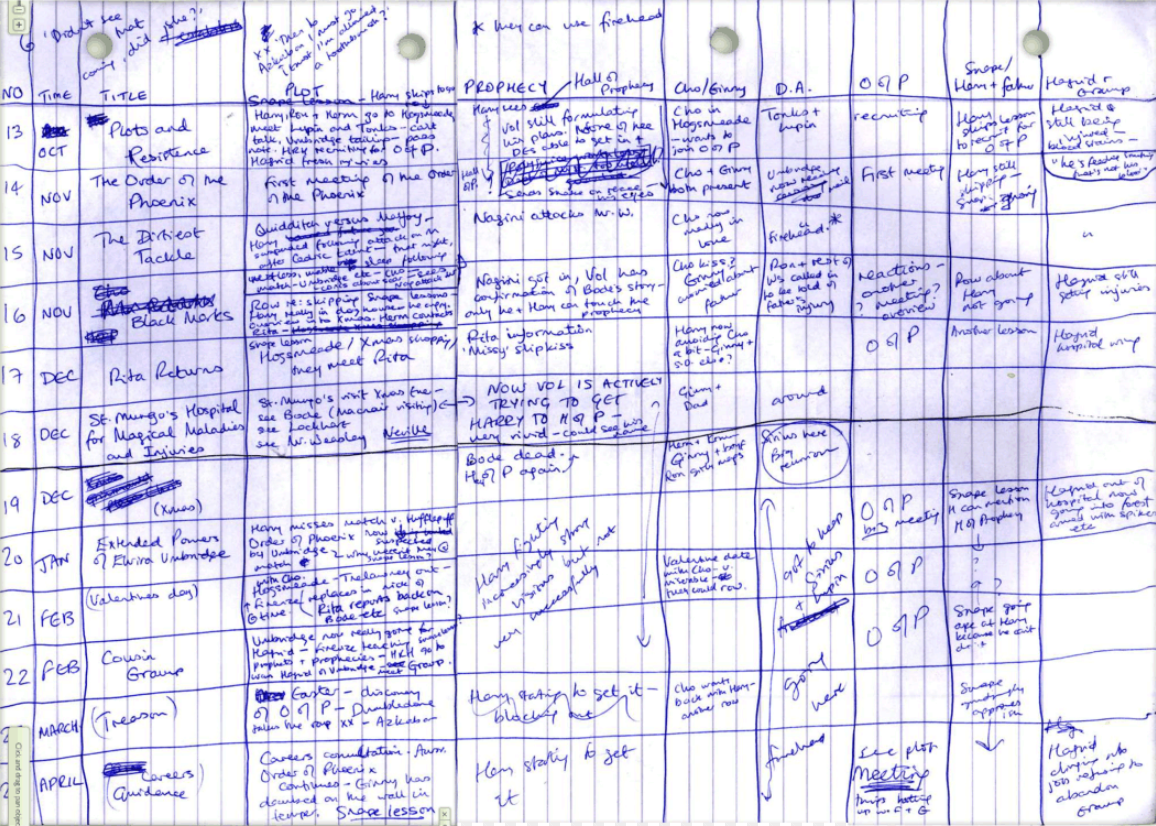
JK Rowling's outline for Harry Potter and the Order of the Phoenix

Rowling’s grid outlines the chapter, month, chapter title, with an explanation of how that chapter relates to the over-arching plot of the book. There are columns for each of the book’s six subplots (prophecies, Harry’s romantic interests, Dumbledore’s Army, Order of the Phoenix, Snape and crew, and Hagrid) as well.

Remembering all the necessary details across hundreds of pages can bog down the heartiest of writers, especially when under deadline. Luckily, there’s a cure!

Creative rejuvenation

Creativity is innate to everyone. Much of what is perceived as “writer’s block” is temporary amnesia, we’ve forgotten the pure joy of having fun. When your creative fuel tank sputters on empty, try the following steps to blast your creativity into orbit:

  1. Do something silly, like running up the Down escalator, jumping on the bed, or having a food fight. Breaking up your routine with something random and unexpected, opens a creative doorway.
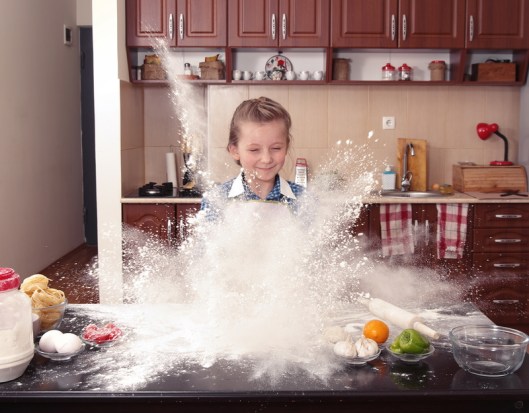
  2. Make a creative mess. A BIG one! Nothing breaks the bonds of orderly stuckness quicker than doing something that’s the total opposite.
  3. Skip. Everywhere. For an entire day! We stop skipping around the age of 10 or 12, but no one knows why. Scientifically that is. I think it’s because that’s the age we start forgetting how to naturally have fun. Skipping for an entire day will force you to remember what it was like to be naturally happy. Instant creativity is the result.
  4. Do something your 12 year-old self loved to do. For me it was rollerblading, but do whatever made you happy at that age. Again, it’s about tricking yourself into remembering what it’s like to be naturally happy. Then, the creative faucet turns on with firehose force.
  5. Give yourself permission to do NOTHING for an entire day. This is harder than it sounds. In our overachiever society, we’ve forgotten how to slow down and live in the moment. For more about this creativity enhancing practice, check out The Art of Doing Nothing, by Veronique Vienne.

Tranquil spa setting


The secret to getting published: Don’t give up!

31 Sunday Dec 2017

Posted by Elizabeth Fais in Inspiration, Writing

≈ 1 Comment

Tags

Elizabeth Fais, Flora and Ulysses, Harry Potter, Harry Potter and the Philosopher's Stone, Inspiration, J.K. Rowling, Kate Dicamillo, Mary E. Pearson, Meg Cabot, New York Times, New York Times Bestselling, On Writing, The Princess Diaries, The Remnant Chronicles, The Tale of Despereaux, Veronica Rossi, writer's life

Writing your first book is a thrill like no other, a total high. Then the rejections come, and reality sets in. Fast. The thing is, rejections are part of the process. Get over it and keep going.

There’s no such thing as an overnight success

That is…unless you count the 10 years of hard work that came before. We’ve all heard the stories of the famous author whose success happened overnight.

The truth is, it didn’t. Successful authors put in years of work before ever getting published.

All that work was the foundation for the great books that lead to their success.

  • J.K. Rowling taught school and then was a researcher and bilingual secretary for years, all the while writing fiction on the side. She was unemployed and near poverty when she wrote the first Harry Potter novel, Harry Potter and the Philosopher’s Stone.
  • Meg Cabot spent several years (!) rigorously submitting manuscripts before landing her agent. She got a book deal after that, but had to keep working at her job and New York University until her success with The Princess Diaries series.
  • Kate Dicamillo received something like 463 rejections before selling her first book. She went on to be one of six people to win two Newberry Medals—for The Tale of Despereaux and Flora and Ulysses—all because she didn’t give up.
  • Mary E. Pearson, author of the New York Times Bestselling series The Remnant Chronicles, admitted at an author event that she wrote five (!) novels that would never see the light of day, and that it took ten years before she sold the one that made her a published author.

The difference between a published author and an unpublished author is that the published author didn’t give up.


How to keep writing while dodging tornadoes

TornadosLife drops roadblocks and raves in our paths—like tornadoes dropping from the sky—forcing our writing onto uncharted detours. Who knew dodging tornadoes would be a valuable writing skill?

There are happy detours, and those filled with sadness and loss. Even life threatening, if you discover a loved one’s being extorted by the Russian mafia and they come after YOU when you publicize their crimes across social media, looping in the FBI. Hey, it could happen. Tornadoes come in all shapes and sizes, all equally disruptive to our writing goals.

Whatever tornado you’re dodging right now…know you are not alone. Here’s a few things that kept me going when tornado dodging got tough:

  • Write something every day. Even if it’s only a note to remind you to write something better tomorrow.
  • Go to author visits. Invariably, you’ll hear the ordeal that published author went through to get their first book deal.
  • Read. Read. Read. It’s the next best thing to writing. You’ll be surprised how much you absorb on craft, especially when reading a variety of genres.
  • Watch TV series in your genre. It’s a great way to study story and character development.
  • Read author blogs that inspire you.
  • Read books on craft that help polish your writing weaknesses. We all have them. Most of us, more than one.
  • Remember what got you excited about writing. Revisit whatever it was that sparked the creative fire that set you on your writing journey.
  • Believe you’ll make it across the publishing bridge after the tornadoes pass. Because you will. As long as you don’t give up.

Rainbow Bridge


Santa writes back! ~ Get a letter from the North Pole

03 Sunday Dec 2017

Posted by Elizabeth Fais in Holiday, Writing

≈ 1 Comment

Tags

Christmas, Elizabeth Fais, letters, merry and bright, Miracle on 34th Street, North Pole, North Pole cancellation, Santa Claus, snail mail, Writing

Yes, Virginia. There is a Santa Claus!

The United States Postal Service can help you prove it too. Santa can reply to your child’s letter from his workshop, complete with a North Pole postmark.

North Pole Postmark

How to get a North Pole postmark

You can make Santa and his workshop real for your child with a personal reply to their letter that includes a North Pole postmark. Here’s how.

  1. Write a letter to your child and sign it From Santa.
  2. Put the letter in an envelope and address it to your child.
  3. Add the return address SANTA, NORTH POLE.
  4. Affix a First Class stamp to the envelope.
  5. Place the complete envelope in a larger envelope with the appropriate postage (to cover the extra weight), and address to:
    North Pole Postmark
    Postmaster
    4141 Postmark Dr.
    Anchorage, AK 99530-9998

If you want to know how writing letters to Santa became a thing, you can read Alex Palmer’s A Brief History of Sending a Letter to Santa in Smithsonian Magazine.

Miracle on 34th Street


The mystery of depth ~ Creating characters we care about

29 Sunday Oct 2017

Posted by Elizabeth Fais in Character, Story, Writing

≈ Leave a comment

Tags

Am Writing, Blake Snyder, Buffy the Vampire Slayer, Character, Character Arc, Elizabeth Fais, Fiction, interiority, Joss Whedon, literary agents, Mary Kole, NCIS, Save the Cat!, SCBWI, SCBWI San Francisco/South, Society of Children's Book Writers and Illustrators, Writing Irresistible Kidlit

Agents and editors want stories that have characters they can care about, characters with depth. For the longest time, I had no idea how to accomplish this. I knew depth meant complexity, but how you created that quality in characters was a mystery. Then one day, while watching an episode of NCIS, the pieces of the character-depth-puzzle magically fell into place. Who knew Abby and Gibbs would be the key that unlocked this literary mystery?

NCIS -- Abby and Gibbs

1. Mix it up with multiple character traits

In a 2-dimensional painting, everything appears flat. You get the same effect with characters that only have one basic trait—bully, geek, mean girl, wimp, etc. To avoid flat characters, give them multiple traits of varying strengths.

I like the analogy of creating perspective in a painting. What’s in the foreground is mountains at sunsetmore intense and has greater detail. As should be the predominant trait of a character. With increased distance in a painting, objects become lighter and have less detail. Secondary and tertiary character traits should have less focus as well.

When Building a Better Character, reveal the traits over time as the character interacts with others and reacts to various situations.

2. Shake & stir: the good, the bad, and the ugly

Just as characters need a blend of traits to be believable, they must also display a variety of emotions. No one is perfect, and we wouldn’t like them if they were. Show their good side, so we like them, but don’t hold back on the bad and the ugly.

  • There are several types of heroes, each with a different set of predominant emotional archetypes. Who’s your hero?
  • Introduce the Quirky Quotient for a memorable, offbeat character.
  • For more subtle depth, weave in idiosyncracies that Build Empathy.

3. Peal back the layers

It’s human nature. The longer we savor an experience, the richer our enjoyment. This is why it’s important for characters to unfold and grow along with the plot.

Think of pealing back the layers of an onion. Each layer should reveal something unique and intimately real about the character. When we first meet someone, we get a superficial impression of who they are. It takes time, and a variety of experiences, before we get to know who they really are. It should be the same with our characters.

At a San Francisco South Society of Children’s Book Writers and Illustrators (SCBWI) Agents Day conference, former literary agent, Mary Kole explained how to explore a character’s inner life through interiority. Interiority is a combination of the character’s internal dialog and point of view. To learn more, check out her book on Writing Irresistible Kidlit: The Ultimate Guide to Crafting Fiction for Young Adult and Middle Grade Readers.

4. Pressure cook for change

diamond sitting on coalCharacter depth requires change over the course of the story. The Character Arc is a journey that forces the character to confront their frailties to become wiser and stronger.

All great stories are about transformation. To survive, the hero has to change by facing their greatest fear and overcoming it. Blake Snyder—in the popular story structure guide, Save the Cat!—called this The Dark Night of the Soul.

Joss Whedon (Buffy the Vampire Slayer) puts characters through hell—literally and figuratively. This pressure has the same effect as the pressure that transforms a lump of coal into a diamond. It smooths off their rough edges and makes them shine.

You take people, you put them on a journey, you give them peril, you find out who they really are. ― Joss Whedon


Humor ~ the secret ingredient that keeps kids reading

16 Sunday Jul 2017

Posted by Elizabeth Fais in Humor, Writing

≈ Leave a comment

Tags

Comedy, Ghost Buddy, Hank Zipzer, Henry Winkler, Humor, Lin Oliver, Marvin Terban, SCBWI, Society of Children's Book Writers and Illustrators, Writing

Kids laughing and readingIf something is fun, we want to repeat the experience as much as possible. Reading is no different. It’s no surprise that for young readers, the key to keeping them reading is humor.

Marvin Terban, master of children’s wordplay and author of over 35 humorous books for young readers, explained the science of reading fun to a packed house at the Society of Children’s Book Writers and Illustrators (SCBWI) Summer Conference in Los Angeles earlier this month.

Terban was a school teacher for decades, learning first-hand how to capture children’s interest 3 Latino children readingand keep them engaged. He was adamant:

“It’s no laughing matter if there’s no laughing matter.”

When children were asked what books they liked to read, this is what they said:

  • My favorite books are the ones I pick myself.
  • I like books make me laugh.

Recipes for laughter

“That’s great,” you say, “but what’s the secret to making children laugh?” You’re in luck! Terban shared a few of the ingredients from his recipe for humor:

  1. Use funny names, like Ralph Puken or Bob Booggensnot.
  2. Use funny words. Apparently the funniest words for young readers are: fart, poop, and underpants. In that order.
  3. Kids (and adults) laugh the hardest at the unexpected.
  4. The funniest scenes contain an element of sorrow.

Lin Oliver and Henry Winkler are also masters of writing comedy for young readers. Kids of all ages love their Hank Zipzer: World’s Greatest Underachiever series and Ghost Buddy series. At a past SCBWI conference, this awesome writing team shared a few of their secrets for writing comedy:

  1. Write what makes you laugh. If you think something is funny, someone else will think so too. Young readers know when humor is not authentic.
  2. Write from your own “most embarrassing” moments.
  3. You have to love the character you’re putting in comedic jeopardy, or else it comes off as being mean. You want your audience to laugh with the character, not at him.
  4. Specific details are almost always funnier than generalizations. For example: Principal Zumba has a mole. Or… Principal Zumba has a mole shaped like the statue of liberty that looks like it’s doing the hula whenever he talks.

Hank Zipzer and Ghost Buddy covers


Nonfiction fun ~ When the truth is more fantastic than fiction!

07 Wednesday Jun 2017

Posted by Elizabeth Fais in Nonfiction, Writing, Young Adult

≈ 2 Comments

Tags

Abraham Lincoln, atomic bomb, Bomb, crime thriller, Elizabeth Fais, Lincoln's Grave Robbers, Nonfiction, Reading, SCBWI, Secret Service, Society of Children's Book Writers and Illustrators, Steve Sheinkin, WWII

Do you have a young reader who isn’t into fiction, yet wants books that are fun? Or perhaps there’s a summer reading requirement looming, and it’d be easier to hog tie the Hulk than to get your kids to read over vacation?

Well…put away the lasso and forget about the Hulk. Your kids will be begging for more, and you’ll want to read these books too. Yes. They’re that good! Thank me later.

kids reading

I discovered Steve Sheinkin’s work at a Society of Children’s Book Writers and Illustrators (SCBWI) summer conference a few years ago. Sheinkin is a master of finding the fun in history, and narrating the facts in an engaging voice and at a thrilling pace. If there were history books like these when I was in middle school or high school, it’s all I would’ve read.

Lincoln’s Grave Robbers, by Steve Sheinkin

This may sound like a crime thriller, because it is. But trust me, it’s not fiction. Someone actually stole President Lincoln’s body, and this fast-paced recounting of the events will have you on the edge of your seat, turning the pages until you’re done.

On October 20, 1875 Secret Service raid the Illinois workshop of master counterfeiter Benjamin Boyd and arrest him. Soon after Boyd is hauled off to prison, members of his counterfeiting ring gather and devise a plan to get Boyd back: steal Abraham Lincoln’s body from its tomb, stash it in a secret location, and demand as ransom, the release of Boyd—and $200,000.00 in cash. 

The action of this true crime thriller alternates among the conspirators, the Secret Service agents on their trail, and the undercover double agent moving back and forth between the two groups. Along the way, we get a glimpse into the inner workings of counterfeiting, grave robbing, detective work, and the early days of the Secret Service. The story races toward a wild climax as robbers and lawmen converge at Lincoln’s tomb on election night, 1876. [Jacket flap]

Bomb, by Steve Sheinkin

This story is close to my heart, because I graduated from a university that played an important—top-secret—part in the race to develop America’s atomic bomb. I didn’t find this out until long after I graduated, and I can’t say I’m proud of the fact. However, this book helped me to reconcile some of my feelings about the United States’ development and use of this deadly weapon. If not us, someone else would have done the same and with potentially more horrific results.

BombNo matter your viewpoint, this telling of the events leading to the creation of the first atomic bomb will keep you spellbound until the last page is turned.

In December of 1938, a chemist in a German laboratory made a shocking discovery: When placed next to radioactive material, a uranium atom split in two.

That simple discovery, dealing with the tiniest of particles, launched a cut-throat race that would span three continents. The players were the greatest scientists, the most expert spies, hardened military commandos, and some of the most ruthless dictators who ever lived. The prize: military dominance over the entire world. 

This is the story of the plotting, the risk-taking, the deceit, and genius that created the world’s most formidable weapon. This is the story of the atomic bomb. [Jacket flap]


Mark Twain and the Kitten that Played Pool

16 Tuesday May 2017

Posted by Elizabeth Fais in Animals, Cats, Writing

≈ 2 Comments

Tags

A Connecticut Yankee in King Arthur's Court, Albert Biglow Paine, cats, Connecticut, Hartford, Huckleberry Finn, kitten, Mark Twain, Mark Twain House, Nook Farm, Puddn'head Wilson, Roughing It, Samuel Clemens, The Adventures of Tom Sawyer, The Innocents Abroad, Tom Sawyer, writer's life, Writing

Twain’s softer side

Mark TwainThe name Mark Twain is synonymous with Tom Sawyer and Huckleberry Finn—rough and tumble boys full of adventure, daring pranksters who were afraid of nothing.

In many ways, the characters an author creates are their reflection. But like Hemingway, Mark Twain had a softer side he hid from the world.

Like so many creative people, Mark Twain was sensitive and more than a little reclusive. People who knew him said he was most comfortable around animals, with a particular love of cats. According the Mark Twain’s daughter, Suzy…

The difference between papa and mama is that mama loves morals and papa loves cats.

Twain loved cats so much he had up to 19 living in his house at one time, according to one source. And that was just at his Connecticut home.

Mark Twain biographer, Albert Biglow Paine, revealed that Mark Twain even traveled with cats. Once on his travels, he missed his cats so much he rented a few local kittens for the summer. “He didn’t wish to own them, for then he would have to leave them behind uncared for,” Paine explained, “so he preferred to rent them and pay sufficiently to ensure their subsequent care.”

The kitten that played pool

It’s odd to think that an author as accomplished as Mark Twain suffered from nervousness about his writing. But he did. His cats helped calm him, as did playing billiards. Amazingly enough, there was one special kitten who did double duty by playing pool with Twain. For real. I am not making this up.

Kitten on pool table

When Twain took a break from his writing to blow off nervous energy, he’d pick up the kitten and tuck him into one of the pockets of the billiard table and the game began. The kitten swiped at the balls as they darted by, amusing Twain to no end. Rejuvenated by the kitten’s antics, Twain could then return to his writing.

Twain’s love of animals lives on

Generations of cats have called Nook Farm home—the famous author’s house in Hartford, Connecticut. Dozens of cats still live on the grounds of The Mark Twain House & Museum today, much as they did during the famous author’s lifetime.

When a man loves cats, I am his friend and comrade, without further introduction. ~ Mark Twain

Many of the staff members at The Mark Twain House are proud owners of Nook Farm cats, continuing Twain’s legacy.

Mark Twain’s love of cats lives on in his writing, as well. Cats stalk, slink, pad, and play their way through many of his best-known books, including The Innocents Aboard, Roughing It, The Adventures of Tom Sawyer, A Connecticut Yankee in King Arthur’s Court, and Puddn’head Wilson. If that’s not reason enough to read Twain, I don’t know what is. But I’m a hopeless animal lover too. What can i say?


Get that Half-Baked Story Out of the Oven!

17 Monday Apr 2017

Posted by Elizabeth Fais in Story, Writing

≈ Leave a comment

Tags

Am Writing, Amie Kaufman, don't give up, Elizabeth Fais, Fiction, Gemina, half baked, Illuminae, Jay Kristoff, Joss Whedon, novel, Story, writer's life, Writing, writing recipe

Writing Recipe for Success

Toddler chefIt happens to every writer. At least once. We start a project, excited and inspired by the sparkly new idea. We run with it, fleshing out characters, working magic with dialog, setting, and plot. Then something happens. Our inspiration dissipates, like air from a hot air balloon. We’re slugging forward through molasses, when once we soared.

It’s easy to get discouraged, or possibly even give up on that great idea at this point. I’m here to tell you…

DO NOT GIVE UP!

Writing a novel is a lot like baking a cake. You carefully organize and mix the ingredients, select and prepare the pan, then put it in the oven to bake at the right temperature for the perfect amount of time. Unlike the cake, a creative oven requires our input for the heat, and the time it takes to fully bake is not always in our favor. Deadliness be damned. Unfortunately, half-baked is only half there.

The good news is that you got the story into the oven. Here’s a few strategies on how you can get it out…fully baked.

Turning Up the Heat

We get stuck in our writing for lots of reasons. The best way to get unstuck is to shake things up, take a new approach, do something totally different. The unexpected has a way of jump starting creativity. Here’s few suggestions:

  • Go someplace you’ve always wanted to, but haven’t. A change of scenery, especially a place that elicits intrigue, works wonders.
  • Watch A LOT of movies and TV shows. Joss Whedon would watch four or five movies in a row (in one day) to study story. You never know what will provide the boost you need for your story.
  • Read A LOT of different things, both magazines and books. Read outside your comfort zone. Change is good. Embrace it.
  • Talk to people who have cool jobs, or who’ve had very different life experiences than your own. This is one of the things Amie Kauffman, co-author of Illuminae and Gemina, does to get new ideas.
  • Go to a public place and people watch. Imagine where they’re going and what they’ll do when they get there. Have fun creating stories without the pressure of an outcome.
  • Start a totally different project in a completely different genre, just for you. Published authors confess to doing this when they’ve been paralyzed under a deadline. TheFemail chef illustration story they started “for themselves” got them excited about writing again and they made their deadline. Those stories later became wildly popular books too. A win-win.
  • Brainstorm with other writers. Especially if you’re under deadline. Screenwriters work this way a lot.
  • Write stuff. Then write more stuff.
  • Fire your internal editor and keep going until you reach The End.

You’re doing great!


“THE PLAYBOOK” of Positivity

27 Monday Feb 2017

Posted by Elizabeth Fais in Author, Inspiration, Writing

≈ Leave a comment

Tags

ball, basketball, Elizabeth Fais, game, Humor, Inspiration, Kepler's Books, Kwame Alexander, New York Times best-seller, Newberry Medal, playbook, poetry, rules for life, Thai Neave, The Crossover, The Playbook, verse, We Need Diverse Books, WNDB, Writing

52 Rules to Aim, Shoot, and Score in this Game Called Life

Playbook coverYou gotta know the rules to play the game. Ball is life. Take it to the hoop. Soar. What can we imagine for our lives? What if we were the star players, moving and grooving through the game of life? What if we had our own basketball rules to help us get what we want, what we aspire to, what will enrich our lives? 

The Playbook by Kwame Alexander was inspired by his Newberry Medal-winning and New York Times best-selling novel The Crossover. The Playbook is filled with uplifting stories … from favorite sports figures … and 52 rules to follow both on and off the court. Kwame Alexander shares his own … stories of overcoming obstacles and winning games. All illustrated with stunning photographs by Thai Neave.

Say Yes! to life

I heard Kwame talk at Kepler’s Books, and can say straight up that The Playbook is a direct reflection Kwame. He’s a fountain of positivity. And it’s contagious. Kwame Alexander walks the talk. Throughout the evening, he shared lessons from his life on being open to possibility.

The most important rule I’ve learned is that when you are presented with an opportunity that may seem different or challenging or unknown, sometimes you’ve got to summon the courage to trust yourself and SAY YES!

That’s exactly what Kwame did when he was asked to teach students how to professionally publish a (print) book of their poetry … in one day!

Kwame Alexander reading from The CrossoverHe initially designed a two-week workshop. During that time the kids would learn how to design, edit, and layout a book. Then, negotiate with printers, define a marketing plan, and arrange for distribution. As life would have it, the school’s schedule shrunk to a one day window. One day! A seemingly impossible task, especially considering the ages of the children he’d be working with.

Yet, Kwame said Yes!

The workshop started at 7:30 in the morning, and by 4:30 that afternoon the kids had their book of poetry on the way to the printer. Kwame’s wife suggested that he take the program to other schools, and he did. He traveled around the country teaching children how to professionally publish a book of their poetry.

Don’t let other people’s NOs define you

Just as important as saying YES to possibility is not listening to other people’s NOs!. Again, Kwame is proof of the wisdom behind these words. The Crossover is a shining example.

The Crossover is the story about 12 year-old twins who are Kwane Alexander reading from The Playbookawesome on the basketball court, and how they come to realize that breaking the rules comes with serious stakes. Kwame’s game is poetry, and The Crossover is entirely in verse.

Poetry…for middle grade readers, targeted for boys no less.

The Crossover was rejected by the first publisher Kwame submitted it to. So he went back and revised the manuscript, only to get rejections from subsequent submissions to other publishers. He kept at it, revising and submitting. After five years, he’d accumulated 20 rejections.

Most people would’ve given up after the first two or three rejections. Not Kwame, because he knew the power poetry had in changing lives. In the poems he wrote to his mother and daughter, and the “alternative school” students in which poetry inspired a lifetime love of reading. Kwame believed in his work. He didn’t listen to other people’s NOs. Thank goodness.

One publisher finally said YES! The rest is history for the Newberry Award winning, New York Times best-selling novel, The Crossover.


LOVE ~ Fiction’s Greatest Common Denominator

14 Tuesday Feb 2017

Posted by Elizabeth Fais in Love, Story, Writing

≈ Leave a comment

Tags

Blake Snyder, Cassandra Clare, City of Heavenly Fire, Elizabeth Fais, Fiction, Hallmark, Hamlet, Harry Potter, Hollywood, Jane Austen, Katherine Applegate, Love, Macbeth, Mortal Instruments, opera, Othello, Rom-Com, Romantic Comedy, Romeo and Juliet, Rossini, Save the Cat!, Severus Snape, Shadowhunter Chronicles, Shakespeare, The One And Only Ivan, Valentine's Day

I love you heart❤️ It’s Valentine’s Day ❤️ 

Love is in the air, whether you adore the holiday or not.

Many bemoan the grandiose expectations the holiday puts on…well…everyone.

Don’t blame Hallmark.

Instead, look to fiction for insights into why this holiday has become a national obsession.

Love … Has Everything to Do With It

As Blake Snyder, Mr. Save the Cat!, used to say, “The motivating force of a story has color heart lightto be primal.” And nothing is more primal than love. I’d go so far as to say that love is fiction’s greatest common denominator, that the roots of every story are based in love.

Whether it’s seeking love, giving love, protecting love, grieving for love, or the ugliness that springs from lack of love or unrequited love.

Shakespeare’s Romeo and Juliet is one of the most popular stories of all time, because it resonates with humanity’s innermost core. Love.

Love’s Joyful Eccentricities

The romantic comedy (rom-com) is the popular love story of today. Shakespeare was the first to make that particular story type popular, though. Shakespeare wrote a total of 16 romantic comedies, earning him the title as the original Rom-Com King. Rossini, and other composers, carried the romantic comedy into the opera houses with great success. Later, Hollywood was quick to spin the romantic comedy into a film genre.

In children’s literature, the net of love stretches to include other species. For example, TheOneAndOnlyIvan_coverin The One and Only Ivan, by Katherine Applegate, a young girl’s compassionate love for Ivan, the shopping mall gorilla, is the catalyst for his freedom.

Likewise, Ivan’s love for the elephants who are also trapped in the roadside shopping mall attraction sparks his imagination and fuels his actions that provide the means for the young girl to help them.

Spanning centuries, artistic mediums, and species…the love story has touched the hearts of audiences everywhere. To such a great extent, it has permeated the fabric of our consciousness. Such is the power of love. Because it’s primal.

Love’s Darker Faces

The primal motivating force of a character always comes back to love. “Even the villain?” you ask. Yes. Severus Snape, in J.K. Rowling‘s Harry Potter series, is a perfect example of denied love giving the character a villainous face.

City of Heavenly Fire coverShakespeare’s dramatic plays reflect the darker facets of love, such as Hamlet, Macbeth, and Othello. Jane Austen, thought by many to be the Queen of Romance in fiction, touches the sadder sides of love in her works, such as Persuasion.

Cassandra Clare‘s Mortal Instruments series is woven through with characters’ experiences and expressions of the grimmer facets of love, that sometimes grow so dark as to perpetuate murder. However, the main theme revolving throughout the series is self-acceptance.

The characters come to see and understand that the choices they make and the consequences that follow are a reflection of their level of self-love. This realization leads some through their darkness, to where they can embrace the healing power of love.


← Older posts
Newer posts →

Calendar

January 2026
M T W T F S S
 1234
567891011
12131415161718
19202122232425
262728293031  
« Nov    

Enter your email address to have new posts sent directly to your inbox.

Join 236 other subscribers

It's really me!

  • Elizabeth Fais's avatar Elizabeth Fais

Life is Tweet

Follow @elizabethfais

Recent Posts

  • The true POWER of stories
  • Wisdom of Richard Peck ~ Writing for young readers
  • The Writer and Rabbit Who Saved the Countryside
  • 3 TREE-rific Informational Picture Books
  • Musings from the Writing Cave
  • MG Review ~ HOW I BECAME A SPY
  • The “Creative High” is real!

Past Posts

Officially SCBWI

Reading Fun

Advice for Writers

I Write for Apples

Author Photos

Olivia Marshall

Categories

Amazing but true! Animals Animation Blake Snyder Book Reviews Books Cats Character Dancing Disneyland Elizabeth Fais Fiction Fun Facts Funny Videos Giveaway Giving Back Holiday Humor Inspiration Middle Grade Movies Music Mystery Nonfiction Paranormal Reading Romance SCBWI Shakespeare Story Supernatural Thriller Uncategorized Winner! Writing YA YAppiest Young Adult Zombies

Blog at WordPress.com.

  • Subscribe Subscribed
    • Elizabeth Fais
    • Join 236 other subscribers
    • Already have a WordPress.com account? Log in now.
    • Elizabeth Fais
    • Subscribe Subscribed
    • Sign up
    • Log in
    • Report this content
    • View site in Reader
    • Manage subscriptions
    • Collapse this bar
 

Loading Comments...