• About Me
  • Writer’s Corner

Elizabeth Fais

~ Where awesome begins…

Elizabeth Fais

Category Archives: Writing

Musings on Costumes, Clothes, & Character

30 Wednesday Oct 2013

Posted by Elizabeth Fais in Characters, Costumes, Research, Writing

≈ 4 Comments

Tags

Characters, Costume Department, Costumes, Elizabeth Fais, Halloween, Universal Studios, Wolfman

Clothes Define Character

It’s almost Halloween. The one day of the year costumes are acceptable … and in some places even expected or required.

The typical question we ask one another at this time of year is, “What are you going to be for Halloween?” This translates to:

What type of costume are you going to wear?

Young woman in old west costumeWhat we choose to wear defines the character we are impersonating on Halloween. By donning the costume we become the character.

I never thought much about that innocent Halloween question in terms of character definition in my writing. Until now. The concept translates directly into how we build characters in fiction.

A person’s manner of dress conveys a lot about their personality … quirks, insecurities, likes, and dislikes.

Clothes styles can also be used to reflect the time and place in which a character lives, or how they view the world. [image from morguefile]

To be over-the-top ridiculous with an example — because it’s almost HalloweenCostumes_zombie-mummy — there is no way you’d think the people (?) in these two photos are anywhere near similar in anything  judging from their style (?) of dress.

The old saying, “Clothes make the man” — or the monster, as the case may be — is directly applicable when it comes to fictional characters too.

Hollywood clued in on the secret of costume = character from its beginning. And they still pretty much own the market in that department. I recently got a tour the Universal Studios Costume Department in Los Angeles, so I can vouch for that fact.

I guess I’m thinking about this sort of thing a lot lately, because I’m in the early stages of a new project. Which means defining the nuances of character — through the clothes they wear — as well as by dialog and action. Props provide another means for defining character, but I’ll save that rather large topic for another blog post.

So…what are you going to BE for Halloween?

Maybe something that incorporates some — or all — of these…?

Halloween costumes

Do tell! Ghoulish minds want to know!

[images by moi, taken at Universal Studios Costume Department]


0.000000 0.000000

Writing Lessons Learned from Garry Marshall’s “Happy Days in Hollywood”

28 Monday Oct 2013

Posted by Elizabeth Fais in Autobiography, Film, Humor, Writing

≈ 2 Comments

Tags

Bing Cosby, Danny Thomas, Dick Van Dyke, Elizabeth Fais, Film, Garry Marshall, Gomer Pyle, Happy Days, I Love Lucy, I Spy, Laverne and Shirley, Mork and Mindy, My Happy Days in Hollywood, Pretty Woman, The Odd Couple, The Princess Diaries, Wake Me When It's Funny, Writing

Garry Marshall headshotGarry Marshall is an entertainer, storyteller, but first and foremost a writer. I didn’t realize the extent of his talents until the day I listened to his Director’s Commentary on The Princess Diaries DVD.

Afterward, I immediately ran out and bought his first book, Wake Me When It’s Funny. A delight, with its real-world insider info on what it takes to be a successful writer … in any biz. It’s all about story … whether it’s a screenplay, a novel, or a comedy skit. [image: Wikipedia]

My Happy Days in Hollywood

A few weeks ago I saw a Twitter post about Garry Marshall’s new book, My Happy Days In Hollywood. I immediately went online and ordered it, except this time I opted for the unabridged audio book version that is read by Garry Marshall himself. A real treat. It’s like sitting in a living room with Garry, while he personally tells you his story.

The Writer

Garry Marshall was one of the sickly kids ever, because he was (and still is) allergic to almost everything. As a boy, his main goal was to get out of bed. But all that time in bed forced him to develop his talent for crafting stories. While all the other kids were outside playing, he’d lay in bed and made up stories to entertain himself. Scary stories made him scared, and depressing stories just made him depressed. So he quickly learned that amusing stories worked the best. He looked at life as comedy, and it stuck with him.

Garry Marshall started as a professional writer for stand-up comedians on the New York City nightclub circuit. From there he went to Hollywood, first writing for Bing Crosby, and then for television shows such as The Danny Thomas Show, The Dick Van Dyke Show, I Love Lucy, The Odd Couple, Gomer Pyle, I Spy, and Love American Style. His time in the writing trenches eventually lead to producing and directing, fist television and later movies.

The Producer, Director, & Actor
Garry Marshall was the creator and producer of some of the most popular television shows from the 1970’s, including The Odd Couple, Happy Days, Mork and Mindy and Laverne & Shirley.

HappyDays

Today, most people know Garry Marshall for his more recent work as a director (the The Princess Diaries movies, 1 & 2) and actor. What you might not realize, is that his writing skills helped shape (and in some instances make) successes through the rewrites he contributed to a script. One of his script-transformation successes was Pretty Woman (1990).

The original screenplay was named Three Thousand, and was a dark story about a thirty-something hooker who falls in love with a wealthy businessman who leaves her, and then she kills herself. Disney execs didn’t think that story would do too well at the box office (duh), so they hired Garry Marshall to direct and “lighten the story up.” The rest is history.

I could go on and on about his other successes as a director, producer and actor, but I don’t want to ruin your experience of reading, or listening to, Garry Marshall’s My Happy Days In Hollywood. Instead, I’ll cut to the chase, with the practical lessons I learned from his autobiography. These are lessons that any writer/actor/artist can use to set their career on the success track. Because as one person so aptly stated…

Garry is allergic to everything but success.

Ten Valuable Lessons

Garry Marshall’s books offer a wealth of life experiences that writers, actors, and artists of all kinds can apply to their careers. Here are ten of my favorite:

  1. Go to school (take classes and seminars), learn and improve your craft.
  2. To succeed in Hollywood (or as a writer) you must be prepared for failure and rejection.  You have to feel it’s noble to fail and learn to rationalize, because you are going to get rejected.
  3. Allow yourself 30 minutes a day for self-pity. Then get back to your writing.
  4. You’ve got to try different things (write different types of stories), hit or miss.
  5. Developing friendships in the industry is important. It’s not always who you know, but you never know when it will help. Besides, it makes everything so much more fun.
  6. Pain + time = humor
  7. The key to directing (or writing) is don’t take it too seriously.
  8. Life is more important than show business (writing).
  9. Spend your money going to film festivals (writing conferences). You might meet someone who will further your career.
  10. The real power in Hollywood (publishing industry) is to have passion for your project. That passion radiates and convinces others to believe in it (and you!) too.

The Purpose of Our Craft

Garry Marshall said he wants to be remembered
“for making films that make you feel good … even if you don’t want to.”

How about you?
How do you want to be remembered as a writer?


0.000000 0.000000

“Comedy Comes From the Heart” & Other Tips From the Fabulously Funny

06 Friday Sep 2013

Posted by Elizabeth Fais in Fiction, Humor, SCBWI, Writing

≈ 15 Comments

Tags

Comedy, Ghost Buddy, Hank Zipzer, Henry Winkler, Humor, LA13SCBWI, Lin Oliver, SCBWI, Society of Children's Book Writers and Illustrators, Writing

A Workshop with Henry Winkler and Lin Oliver

This year’s SCBWI Summer Conference in Los Angeles (August 1-5) was the ultimate blend of inspiration, guidance, and professional advice for children’s authors and illustrators. All the workshops were amazing, but one was particularly memorable for its advice and inspiration: Comedy Comes from the Heart, with Henry Winkler and Lin Oliver.

  • Henry Winkler is an actor, producer and director, who is best known for his role as “the Fonz” in the 1970’s television series “Happy Days”. Though he is quick to tell you that he’s most proud of writing books for young readers.
  • Lin Oliver is the co-founder of the Society of Children’s Book Writers and Illustrators, a long-time television writer, and a well published children’s author.

LinOliver_HenryWinkler_LA13SCBWI

Henry Winkler and Lin Oliver are two of the funniest people on the planet. Put them together in the same room and it’s no wonder things spiral virally into the hilarious.

This dynamic duo teamed up to write 17 books in the Hank Zipzer: World’s Greatest Underachiever series, and have completed four books in the Ghost Buddy series. They are both are hilarious, and they know how to translate that humor onto the written page. You can read my review of Ghost Buddy ~ Zero to Hero here.
Hank Zipzer and Ghost Buddy covers

The Do’s and Don’ts of Writing Comedy

Henry Winkler and Lin Oliver earned their Fabulously Funny street creds on the page as well as the screen. They know what works, and what doesn’t, when it comes to comedy. Here are some of the comedic secrets they shared with us:

  1. Write what makes you laugh. If you think something is funny, someone else will think so too.
  2. Write what you know is true. Don’t try to write what you think will be funny for a particular audience. Young readers know when humor is not authentic.
  3. There are different types of humor, such as character humor, physical humor, observational humor. Write the type of humor that works for you, what you think is funny.
  4. What makes you laugh the most, also makes you cry the most. Good comedy always has a cringe-worthy (pathos) moment.
  5. Write from your own experience. Mine your own life for “most embarrassing” moments.
  6. You have to love the character you’re putting in comedic jeopardy, or else it comes off as being mean. You want your audience to laugh with the character, not at him.
  7. Good comedy must have tension, just like good drama.
  8. Specific details are almost always funnier than generalizations. For example: Principal Zumba has a mole. Or… Principal Zumba has a mole shaped like the statue of liberty that looks like it’s doing the hula whenever he talks.
  9. Don’t edit yourself on the first draft. Go with your first impulses. Craft the humor afterward.
  10. Use improv to get into the character’s voice. Henry Winkler showed us how a slouch and a tilt of the head, brought out “the Fonz” in his voice.
  11. Titles are very important to young readers. Take the time to craft a terrific title.
  12. “Trying” to be funny is a formula for death. Write down 25 things that made you laugh, then analyze each instance for the elements that made it funny.

Henry Winkler embellishes an explanation for the audience [photos by moi]…

Henry Winkler acts out advice to writers

The following advice from Henry Winkler was particularly inspiring:

There’s many ways to do things. You have to be courageous enough to do things your way.

For information on some of the other amazing workshops at the LA13 SCBWI Summer Conference, you can read the official SCBWI blog.


0.000000 0.000000

Demystifying the Logline with the “ACME Instant Logline Generator”

20 Tuesday Aug 2013

Posted by Elizabeth Fais in Blake Snyder, Save the Cat!, Story, Writing

≈ 4 Comments

Tags

ACME Instant Logline Generator, Blake Snyder, Elevator Ptich, Elizabeth Fais, Hollywood, LA13SCBWI, Logline, Matthew Wright, Save the Cat!, SCBWI, Society of Children's Book Writers and Illustrators, Story

The Illusive, and Often Anxiety Inducing, Logline

We writers spend months, sometimes years, slaving over a novel in order to get the story just right. Then we’re told we have to boil down our labor-of-love—with its three-dimensional characters, intricate plot and subplots, and dynamic dialog—into one sentence (of 25 words or less).

This is known as a logline, or elevator pitch. Some say it is what you have to have to get your dream agent / book deal. Yeah, no pressure there. Right. Tell it to this guy.

Believe it or not, publishing gremlins did not spend months dreaming up loglines as a new and entertaining way to torture writers, both published and pre-published. Hollywood has been using loglines since Hollywood became… well … Hollywood. That’s because, loglines are a quick way to test out story ideas.

The secret, I learned from Blake Snyder’s “Save the Cat!” approach to story structure, is to perfect your logline BEFORE you write your 400 page tome. This is because…

If you don’t have a solid logline, you don’t have a solid story.


Loglines Aren’t Just for Hollywood Anymore

At the Society of Children’s Book Writers and Illustrators Annual Conference in Los Angeles (check out the #LA13SCBWI blog), the topic of loglines came up in several workshops. Children’s authors are not immune from needing a good logline anymore.

Blake Snyder aptly described the value of a good logline:

A good logline is the coin in the realm of Hollywood and can be traded like currency with those who appreciate it.

“How do you grab that illusive gold logline coin for your story?”

Generator with light bulbs and knobsIt’s easy! Use the ACME Instant Logline Generator.

I’ve come across several logline formulas, but the easiest and the most fun is the ACME Instant Logline Generator.

I wish I could take credit for the genius behind the ACME Instant Logline Generator. But this unique and humorous one-from-column-A and one-from-column-B method of demystifying the process for creating a logline was devised by M.J. Wright, an author whose blog I follow. You can view the originial blog post here. Or, read the reblogged version here…

The ACME Instant Logline Generator

All novels need a logline, sometimes also known as a hook line – a single sentence that describes the plot and acts as a sale pitch to agents and publishers.

The form is usually “[Character name], [character description] has to [action] in order to [result].”

The result usually has an emotional content. Hard to winnow your story down to it? Try this. Begin with the logline instead. All you need, in fact, is a six-sided dice. Roll once for each variable and complete the sentence:

1. Roger Dodger the old Codger,
2. Peregrine Hyphen-Hyphen Folderol,
3. Snoot,
4. Adele,
5. Eric,
6. Heinz Dasistwirklicheinesehrdummelangeswortistesnicht von Abernatürlichistesjaabsolutichdenkeso of Sehrgutwerdeichgehenundhöreaufmeinekraftwerkalben,

1. a world-renowned horologist,
2. a rock god,
3. an up-and-coming railway enthusiast,
4. a truck driver specialising in cab-over series Macks,
5. an unemployed random-generator writer,
6. a rodent exterminator,

has to

1. win a challenging drag race
2. build a box-girder bridge with a toothpick
3. write a vampire fan-fic novel
4. learn how to sing and dance
5. cook a souffle
6. defeat the evil Thog monsters from Planet Zil

in order to

1. become the Ruler of the Universe.
2. rescue beloved from certain doom.
3. be home in time for tea.
4. get to Buckingham Palace and receive a knighthood.
5. audition for ‘America’s Got Talent’.
6. finish up at the beginning again, only better for it.

Have fun.

Copyright © Matthew Wright 2013


If you need more intel before tackling a logline, no worries! Nathan Bradford wrote a great post on How to Write a One Sentence Pitch that you can read here.

Easy peasy? You know it!

Your dream agent/book deal is just a logline away.


Discovering Manhattan: A Pictorial Tour of My Protagonist’s World

12 Friday Apr 2013

Posted by Elizabeth Fais in Central Park, New York City, Research, Story, Writing

≈ 9 Comments

Tags

Belvedere Castle, Calvert Vaux, Central Park, Central Park Conservancy, Cleopatra's Needle, Elizabeth Fais, Ellen Gregory, Frozen Hot Chocolate, Manhattan, Metropolitan Museum of Art, New York City, NY13SCBWI, NYC, SCBWI, Serendipity 3, Subway, The Met, The Plaza Hotel, Waldorf Astoria

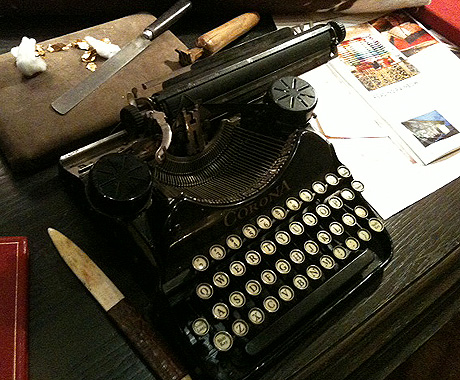
Manual typewriterResearch is one of my favorite parts of the writing process. It’s an intriguing exploration into worlds-yet-unknown, where the story comes to life and becomes real.  I had a few final details to research in Manhattan for my project, which was major reason behind my coast hopping to New York City in early February. (pic by moi)

Yes, I went to NYC to attend the Society of Children’s Book Writers and Illustrators Winter Conference (NY13SCBWI), which was wonderful in all the ways such conferences are. But I had another agenda too… Research.

The Character of Central Park Landmarks…

My project takes place in and around New York City’s Central Park, and a couple of the landmarks played such an important role in the story that they became characters themselves…

Cleopatra’s Needle: The oldest man-made object in Central Park
Image by Central Park Conservancy, the organization responsible for restoring and maintaining Central Park’s historic beauty.

CentralPark_obelisk-l

Belvedere Castle: Built in 1869 by Calvert Vaux
Image by Central Park Conservancy

Belvedere Castle, Central Park NYC

Her Way is the Subway…

Most New Yorkers use public transportation to get around town. My protagonist is no different. She uses the subway, so I followed in her footsteps. There beneath the streets of Manhattan, I discovered the amazing signage from a bygone era (pic by moi)…

86th Street Subway Tile marker

Historical Ruins in the Metropolitan Museum of Art

The Metropolitan Museum of Art is important to my protagonist and her story as well, so I had to experience the collection first-hand. What impressed me most (and I was an art major, so I’ve been to lots of art museums) is that The Met houses reconstructed historical rooms and ruins … not just the typical types of art (pics by moi)…

Metropolitan Museum of Art, NYC

Serendipity 3: Frozen Hot Chocolate

Like many teenagers, my protagonist loves coffee and chocolate. And what better place to meet her friends than Serendipity 3? While conspiring, they consume coffee drinks and Serendipity’s world-famous Frozen Hot Chocolate. Which is to die for, by the way (pics by moi)…

Serendipity 3, NYC

The Plaza … Of course!

My next stop was The Plaza Hotel, where my protagonist’s grandfather owns a private suite. Yes, on the top floor … one with a turret. Eloise does not have anything to do with my story, but I had to take this picture because nothing says “The Plaza” like Eloise. The photo on the right is of The Palm Court restaurant (pics by moi)…

The Plaza Hotel, NYC

Hiding Out at The Waldorf Astoria…

Last but not least was a visit to The Waldorf  Astoria, where my protagonist is forced to go into hiding. Yeah, I know. Tough break sistah. You might wish you had her financial backing … but you don’t want the problems tied to it. Trust me.

The lobby of The Waldorf Astoria is an architectural marvel…

NYC14

How do you discover your character’s world?

Ellen Gregory’s recent post on her “research” experience with beads and braids, inspired me to share this pictorial research tour.

What type of research helps you discover your character’s world?


Why Writing is Like Baseball

26 Saturday Jan 2013

Posted by Elizabeth Fais in Baseball, Humor, Writing

≈ 2 Comments

Tags

A League of Their Own, Baseball, Damn Yankees, Elizabeth Fais, Geena Davis, Madonna, Rosie O'Donnell, Tom Hanks, Writing

If you’ve stopped by this blog recently, you’ll remember that I’m currently under a self-imposed deadline to finish the revision of my Young Adult (YA) novel.  Now, I admit that I tend to get a little punchy at this stage of a long-haul. But no, I haven’t gone completely around the bend. Yet.

NoCryinginBaseball5

“There’s no crying in baseball” scene from A League of Their Own

8 reasons why writing is like baseball

  1. Writers are in a League of Their Own.
  2. The publication process is a team effort — writer, critique partners, agent, editors, graphic designers.
  3. It’s an American (and a whole lot of other cultures too) dream — seeing something we’ve written in print.
  4. Personal history (backstory) affects baseball players as much as it does our characters. Take the players’ personal issues in Bull Durham that stop the game with a prolonged huddle on the pitcher’s mound.
  5. You need a tough hide to survive the slides. Rejection isn’t pretty. Or easy. Ever. And it’s part of the process.
    LeagueOfTheirOwnSlide
  6. You’ve gotta have heart to make it in the industry. An entire song in Damn Yankees can’t be wrong.
  7. Shoes are optional. Shoeless Joe Jackson set the precedent there. Would Damn Yankees  (Shoeless Joe from Hannibal Mo) lie? I don’t think so!
  8. Sometimes you win, sometimes you lose, and sometimes it rains. But it’s fun, goddamit!

I write because the “hard” is what makes it Great!


What about you? Why do you write?


How NOT to Skate Through Revisions

06 Sunday Jan 2013

Posted by Elizabeth Fais in Animation, Perspective, Writing

≈ 12 Comments

Tags

Bambi, Elizabeth Fais, NaNoRevMo, Revisions, Thumper, Walt Disney Studios, Writing

This past year was a whirl wind of firsts, including a new job and blogging for the first time ever. I also started the final revision of my Work In Progress (WIP) — a Young Adult (YA) supernatural mystery. All good. It’s been terrific, really.

Bambi-on-ice2But… there was an itsy-bitsy snag  in the midst of the newness. With all the new shiny things in my life, progress on my WIP revisions slowed to a negligible crawl. Which is why come November, when everyone else was NaNoWriMoing, I lead a NaNoRevMo Charge on revisions for my WIP.

It was great tapping into the NaNo synergy. I got back in the groove, and the revisions were going well.

And then … life happened. What’s that they say about “making plans is the best way to make the universe laugh. In your face.”? Well, the universe was rolling around on the floor laughing at me…

Because it played out something like this…


Well… ALMOST… I won’t bore you with the deets, but here’s the general rundown:

  1. I had to trap and relocate an entire colony of feral cats, when the property where I’d been feeding them went up for sale. No small task, and especially stressful since I’d cared for these cats every day for more than 9 years.
  2. All the while, I had to keep on top of deadlines at the day-job. Nothing new there. But trapping the colony of feral cats in my spare time left no bandwidth for revisions. Zero. Zip. Nada. Zilch.
  3. To top that all off, a killer cold knocked me flat and bronchitis shoved me head first into the proverbial snow bank. Luckily, after the cats made it to their new home. Deadlines at the day-job still had to be met, and I got the job done! But progress on the revisions? None what so ever.
  4. Finally… I started feeling better. And now…

I’m back in the groove & skating on through…

Bambi-and-thumper-on-ice1I’ve sailed well past the half-way mark of the WIP revisions, and can actually see the light at the end of the tunnel. Yay, me! Since I’m driven by deadlines, real or self-imposed, to keep the momentum going I drew a deadline for final completion on the calendar. Then I started realigning priorities. I’m confident I’ll be able reach the finish line in a relatively short time. But that means … something’s gotta give.

Sadly, this blog has to go dark … for awhile

Only for a few weeks folks… And  that’s not to say I won’t post a funny video somewhere along the line. *wink, wink* Just no substantial content, as I need to focus my full attention on my WIP revisions … for now.

I’ll be back after the revision break. Promise!

I have a great series of posts planned for the coming year. But before I can dig intoSteamLocomotive_Wikipedia writing those awesome articles, I have to finish this WIP, so I can hop on the Literary Agent Submission Train.

I’ll see you all in a few weeks on the other side of the deadline! I’ll miss you guys, but this Revision Interlude will pass before we know it! [Image credit: Wikipedia]

Encouragement & the Long Road to “The Princess Diaries”

31 Monday Dec 2012

Posted by Elizabeth Fais in Inspiration, Meg Cabot, Writing

≈ 9 Comments

Tags

Anne Hathaway, Elizabeth Fais, Encouragement, Gary Marshall, Inspiration, Julie Andrews, Laura Langlie, Meg Cabot, My First Sale, The Princess Diaries, Walt Disney Studios, When Lightning Strikes, Writing

hThe sweet strains of encouragement have been floating around the blogosphere of late. Encouragement on querying, handling rejection, and battling the insidious self-doubt.

I listed a few of these inspirational posts below, in case you missed them. They might be just the thing you need to pull out of the Pit of Despair, or plow through rejections to land an Uber Agent and sign a Shiny Book Deal. You never know. Stranger things have happened.

~ o0o ~

Today I’d like to share a true story that has encouraged me to stay the course on my writing journey and keep on keeping on…

The Long Road to “The Princess Diaries”

ThePrincessDiariesCover_Whenever we hear about an author that’s become a huge success, it’s easy to be fooled into believing that “it happened overnight”. Like that author drank some kind of secret instant-success formula and never had to work diligently on craft, or suffer the rejections of submission roulette. 99.99% of the time this is so not the case. And certainly wasn’t for  Meg Cabot of Princess Diaries fame (and beyond).

I found out just how hard Meg Cabot worked to become a published author, in the article she wrote  titled My First Sale. Believe it or not, she slugged through more than her share of rejections on the road to publication (never mind the getting famous part).

In her article, Meg honestly admits that it took her several years (yes, years!) of rigorous submissions, followed by subsequent rejections, before landing her agent, Laura Langlie, who she is still with today. Through it all, Meg saved every rejection letter (before email submissions were the norm) in a US postal mail bag that she kept under her bed. The rejection mail bag ended up becoming so full (with rejections from editors and agents) that it’s now  too heavy for Meg to lift.

To this day Meg Cabot admits that she doesn’t know why she didn’t quit. But she didn’t! Much to the delight of her many readers world-wide.

After signing with her agent, Laura Langlie went on to sell one of Meg’s Victorian romances (Where Roses Grow Wild), written under the name Patricia Cabot. But to this day Meg considers landing her agent as her first sale. Other book deals followed, but three years later (at the age of thirty) Meg was still working her day-job and writing when she could make the time.

ThePrincessDiariesMovieIt was about the time that Meg began writing a book about a 14 year-old girl who discovers she’s a princess. When Meg told her agent about the story, Laura remarked that she thought it would make a great movie. Meg scoffed, but Laura went ahead and pursued Hollywood connections anyway.

Others soon saw the potential for Meg’s princess story too, like the assistant editor at Harper Collins Children’s Books who snapped up the manuscript. Not long after, a call came from Hollywood informing Meg that Gary Marshall wanted to direct the film version of her story and that Julie Andrews signed on to star as the grandmother. Level-headed Meg still wouldn’t believe the hype. That is, not until a check with an awful lot of zeros showed up in her mail box.

Encouragement_MegCabotAutographYou know the rest… Walt Disney Studios produced two Princess Diaries movies, both directed by Gary Marshall and starring Julie Andrews and Anne Hathaway. And lets not forget the nine bestselling sequels that followed in the Princess Diaries series, or the too-numerous-to-mention other bestsellers Meg Cabot has published since.

All because she didn’t give up!

What impresses me about Meg Cabot is that even after all the success, she hasn’t forgotten what it took for her to get there. I attended a San Francisco book signing of hers a year or so ago, and this is what she wrote in the book that (I told her) helped me find my writing voice. It doesn’t get much better than that!

Need Encouragement? These Posts Rock It!

  • How Do We Handle Rejection and Keep on Pressing? — Kristen Lamb’s Blog
  • Triumph & Perseverance — Thinking to Inking

What has encouraged you on your writing journey?

If you know of an encouraging blog post that’s not listed above, please add the link in the comments. I’m sure we’ll all benefit from it!


Animated Storytelling: The Character of a Walk

10 Saturday Nov 2012

Posted by Elizabeth Fais in Animation, Character, Story, Writing

≈ 1 Comment

Tags

Animated Storytelling, Disney's Nine Old Men, Elizabeth Fais, Frank and Ollie, Frank Thomas, Ichabod Crane, Legend of Sleepy Hollow, Ollie Johnston, Pinocchio, Stacy Stokes, Walt Disney

Good animation is based on good storytelling, conveying thoughts, feelings, and emotions by showing rather than telling. One of the principle ways of defining character in animation is “the walk”.

It’s All About the Walk

In animation, “the walk” of a character is everything. That’s because a simple walk isn’t … well … simple. Visually, it is one of the most defining parts of a character. A walk reveals personality and telegraphs mood. You can tell how someone feels by the way they carry themselves, move their arms, and by the quickness or slowness of their step.

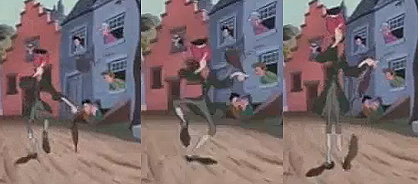
Ichabod Crane, in Walt Disney’s “The Legend of Sleepy Hollow”

Walking With Emotion

In short, a walk conveys character and emotion without saying a word, for example:

  • Depressed, discouraged: Head down, shoulders slumped, hands in pockets, slow steps, dragging their feet
  • Happy, elated: Head high, shoulders back, arms swinging, bouncy steps
  • Angry, determined: Leaning forward, chin jutting out, brisk pace
  • In love: Ambling stroll, relaxed, distracted gaze, blissful smile

An extensive resource for conveying emotion through action is The Emotion Thesaurus: A Writer’s Guide to Character Expression. Keep a copy by your side while you are writing and revising. You won’t regret it!

Walk in Your Character’s Shoes … Literally

A great way to internalize a character’s mood is to imitate their walk. The old saying “walk a mile in someone else’s shoes” is too true. Which is why mimicking character movements is a common practice for animators. They physically act out scenes as their character, to study action and emotion.

Savvy writers do this too. Stacy Stokes,  took an improv class to study character first-hand. You can read about her experience in Walking Game (Things I Learned in Improv Class, Volume 4: Getting Into Character).

Tips From a Pro

Ollie Johnston, one of Walt Disney’s “Nine Old Men“, shared the following insights for enhancing character through motion:

  • Show ideas or thoughts, with the attitudes and actions.
  • Let the body attitude echo the facial expression.
  • Show what your character is thinking.
  • The thought and circumstances behind the action are what make the action interesting.  Here’s an example: A man walks up to a mailbox, drops in his letter and walks away. … OR … A man desperately in love with a girl far away rushes to the mailbox, then carefully drops the letter, into which he has poured his heart out, into the mailbox with a sigh.

For more tips on showing emotion through movement, visit the Frank and Ollie web site.

Contrasting Characters and Their Walks

Theory is all well and good, but I’m one of those people who need examples in order to learn. The following two clips show the walks of two opposite-poles characters, Ichabod Crane and Pinocchio. See how much of their characters you can discern just from studying how they walk.

  • Ichabod Crane in Walt Disney’s “The Legend of Sleepy Hollow”…  Ichabod has a walk like no other. It’s one of the most distinctive walks in Disney animation, thanks to legendary animator Frank Thomas. I’d apologize for the “White and Nerdy” song this is set to, if it weren’t so fitting for the character!


  • Then there’s Walt Disney’s “Pinocchio”… You couldn’t find a more different character from ol’ Ichabod, and it’s immediately apparent from Pinocchio’s walk. There’s no music, but something “Short and Bouncy” would have been fun.


What do you notice most about the way someone walks?


The NaNoRevMo Charge!

03 Saturday Nov 2012

Posted by Elizabeth Fais in NaNoRevMo, Writing

≈ 4 Comments

Tags

Elana Johnson, Elizabeth Fais, NaNoRevMo, NaNoWriMo, National Novel Revising Month, National Novel Writing Month, Revising

Some of you may know that I’ve been slugging my way through the (hopefully) final revision of my Work In Progress (WIP). I’m hip deep in ripping-and-revising, but progress has been slow going (for lots of reasons).  I knew if I stopped to dash off a new project for NaNoWriMo, I might never complete this WIP, and I wasn’t willing to take that risk. So, what to do? I needed a dose of serious inspiration. Then I realized…

When revising gets tough, the tough do NaNoRevMo!

I learned about the National Novel REVISING Month cavalcade from Young Adult Author, Elana Johnson’s recent blog post. My immediate reaction was, “Sign me up!”

I’m late to the NaNo starting gate so I’ll have to charge ahead to catch up. Especially considering how much work still needs to be done on this revision. It’s borderline insanity. But that’s ever stopped me before.

So, here it goes. From this day through the end of this month, my goal is to revise the following until they shine:

  • Young Adult supernatural mystery WIP
  • The query letter for this project

The Charge of the Write Brigade!

As I embark upon the Charge of the Write Brigade, my blog posts may be less frequent. But with so many folks participating in NaNoWriMo, I know everyone will understand. My motto for the rest of this month is going to be:

Sleep when you’re dead!


Is Anyone else focusing on revising this month?

← Older posts
Newer posts →

Calendar

January 2026
M T W T F S S
 1234
567891011
12131415161718
19202122232425
262728293031  
« Nov    

Enter your email address to have new posts sent directly to your inbox.

Join 236 other subscribers

It's really me!

  • Elizabeth Fais's avatar Elizabeth Fais

Life is Tweet

Follow @elizabethfais

Recent Posts

  • The true POWER of stories
  • Wisdom of Richard Peck ~ Writing for young readers
  • The Writer and Rabbit Who Saved the Countryside
  • 3 TREE-rific Informational Picture Books
  • Musings from the Writing Cave
  • MG Review ~ HOW I BECAME A SPY
  • The “Creative High” is real!

Past Posts

Officially SCBWI

Reading Fun

Advice for Writers

I Write for Apples

Author Photos

Olivia Marshall

Categories

Amazing but true! Animals Animation Blake Snyder Book Reviews Books Cats Character Dancing Disneyland Elizabeth Fais Fiction Fun Facts Funny Videos Giveaway Giving Back Holiday Humor Inspiration Middle Grade Movies Music Mystery Nonfiction Paranormal Reading Romance SCBWI Shakespeare Story Supernatural Thriller Uncategorized Winner! Writing YA YAppiest Young Adult Zombies

Blog at WordPress.com.

  • Subscribe Subscribed
    • Elizabeth Fais
    • Join 236 other subscribers
    • Already have a WordPress.com account? Log in now.
    • Elizabeth Fais
    • Subscribe Subscribed
    • Sign up
    • Log in
    • Report this content
    • View site in Reader
    • Manage subscriptions
    • Collapse this bar
 

Loading Comments...