• About Me
  • Writer’s Corner

Elizabeth Fais

~ Where awesome begins…

Elizabeth Fais

Monthly Archives: July 2014

Confounding Colloquialisms: Expressions that make you go, “What?”

28 Monday Jul 2014

Posted by Elizabeth Fais in Fun Facts, Humor, Writing

≈ 5 Comments

Tags

Americanism, Bite the dust, colloquialism, Elizabeth Fais, Independent as a hog on ice, informal expressions, Till the cows come home, Two shakes of a lamb's tail, Writing

A colloquialism is a word, phrase or other form used in informal language.

Parents can say some pretty weird things. My father grew up in Iowa, the heart of the Midwest, so some of the things he said seemed weirder than normal to us California-kids. Like the time he scolded my sister at the dinner table, saying she was “As independent as a hog on ice.”

Our reaction: “Huh?” (Could’ve been, “WTF?” but we weren’t allowed to swear.)
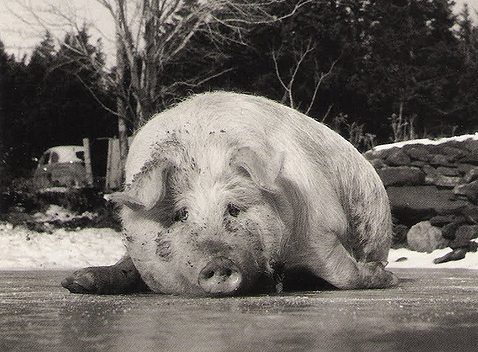
Hog on ice

Seriously. We’d lived in Southern California all our lives and had never seen ice or hogs in real life. We just stared. He took our stunned silence for acceptance and compliance, which was probably a good thing. For a lot of years, I assumed the hog-on-ice thing was an my dad’s own home-grown Iowanism. That is, until I started on my writing journey.

When I started writing, I started to notice all the odd informal sayings we used every day. I knew the implied meanings from the context in which they were used. But the meaning itself? Not so much.  That’s why I decided to take on a handful of these oddball sayings…

“As independent as a hog on ice” Flailing about

Strangely enough, I’m not the only one who has been confused by this saying. This phrase has been baffling people for decades. Yes, decades! Etymologists started searching for an explanation from the time it first appeared in the mid 19th century. In 1948 Charles Earle Funk titled his first book of word origins “A Hog on Ice”. His foreword contains a seven (7!) page narrative of his inconclusive quest for the roots of this phrase.

The Oxford English Dictionary defines the phrase as “denoting independence, awkwardness, or insecurity.” That about sums it up for a hog that’s slip-n-sliding across the ice, much like Thumper and Bambi in the Disney animated feature. “You’re doing it your way, and making a mess of it,” was what my father meant by his independent-as-a-hog-on-ice speech.

Time magazine usage in 1948, “They like to think of themselves as independents … independent as a hog on ice.”

“In two shakes of a lamb’s tail” Fast, really fast

In general usage, it is easy to infer that this phrase means “a very short period of time”.LambsTail
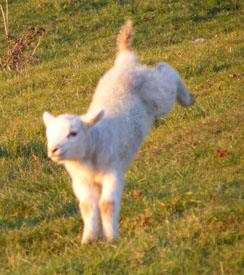
But why a lamb’s tail, of all things, to measure time by? Seriously. A little historical sleuthing uncovered that this is phrase is a distinct Americanism that dates back to the early 1800’s.

Apparently, a lamb can shake its tail pretty darn fast, much faster than other animals. Who knew? The term crossed “the pond” during the World War I, and became popular as British army slang.

“Bite the dust” ~ To die
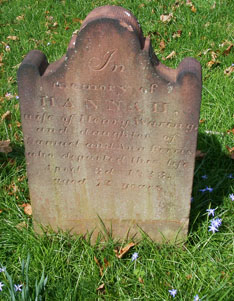
Tomb stoneI always associated this phrase with westerns. So I was not too surprised to discover that it was made popular by American westerns of the 1930’s. Picture a cowboy falling to the ground after being shot, and quite literally biting the dust when he lands face down. Because of its association with westerns, I was completely taken aback that the phrase actually dates  back thousands of years before, to Homer’s Iliad. The following  translation was made by American poet, William Cullen Bryant, in 1870:

His fellow warriors, many a one, fall around him to the earth and bite the dust.

Some might say that Bryant introduced the phrase in his interpretation of Homer.  But I’m not going to argue that point. It works for m.

The phrase also appeared in the mid 1700’s in Tobias Smollett’s translation of Alain-Rene Lesage’s novel “Gil Blas (1715-1745):

…we make two of them bite the dust.

Again, the accuracy of the translation could be open to debate. However, I think it’s interesting that traces of the phrase date so far back.

“Till the cows come home” ~ A very long time

If you grew up in a city with no exposure to cows or farm life, this phrase makes absolutely no sense whatsoever. That’s because the expression alludes to cows’ fondness for extended leisure time out at pasture where there is lots of green grass to munch on. The cows would only rush back to the barn when their udders hurt and needed milking.

The phrase originated back in the late 1500s to early 1600s. But again, it was the cinema of the 1930s that made the expression popular. Groucho Marx used it in Duck Soup (1933) when he said to Margaret Dumont,

I could dance with you till the cows come home. Better still, I’ll dance with the cows till you come home.

Cows in a green pasture

Images: morguefile.com


What’s your favorite confounding colloquialism?


Historic Hollywood Bowl: Hosts The Beatles to Beethoven

14 Monday Jul 2014

Posted by Elizabeth Fais in Architecture, Historic, Music

≈ 6 Comments

Tags

Architecture, Beethoven, Classical Music, dining, Elizabeth Fais, Historic, Hollywood Bowl, Joshua Bell, Music, Musicals, picnics, The Beatles

I was excited about attending a recent concert at the Hollywood Bowl (Joshua Bell and Friends), in Los Angeles, and couldn’t help sharing the news with whoever would listen. I was shocked when two different people asked, “What’s the Hollywood Bowl?” It was all I could do not to say, “Are you kidding?” I grew up on Southern California. But still. The Hollywood Bowl is an American icon, and has been used as a setting in films and television for years.

I would have dismissed one person not knowing about The Bowl. But two was a cry from the universe to write this post. Attending a performance at the Hollywood Bowl is a bucket list kind of thing.

Everything is better at the Bowl. It just is…

Hollywood Bowl, Los Angeles, CA

[image: Wikipedia, by Mathew Field]

From Rustic to Iconic

The Hollywood Bowl is the largest natural amphitheatre in the United States, located in the Hollywood area of Los Angeles, California. When the Bowl opened to the public in 1921, it was used in its natural state with only makeshift wooden benches for the audience to sit on, and a simple awning strung up over the stage.

The popularity of the venue grew with the boom of the film industry, and by 1926 designs for a permanent stage were underway. For the 1927 season, Frank Lloyd Wright‘s son Lloyd Wright built the first of the iconic shell structures. By 1929, the Allied Architects built a shell that stood on the site until 2003. A larger and acoustically improved shell debuted in the 2004 summer season, incorporating design elements from the 1929 shell and the first shells designed by Lloyd Wright.


First known musical event at the current site of the Hollywood Bowl, Los Angeles

[image: public domain, USC digital Library]

The two women in the photograph above are performing on the barn door (1920) to test the acoustics of the site, the first known musical event at the Hollywood Bowl. The barn door was placed approximately where the band shell was built.

Classical to Rock and Roll

A common misconception about the Hollywood Bowl is that it caters solely to the classical music crowd. The LA Philharmonic and Hollywood Bowl Orchestra both make their home there, but each season hosts productions from a wide variety of musical styles. For a complete list of upcoming performances, visit the Hollywood Bowl website.

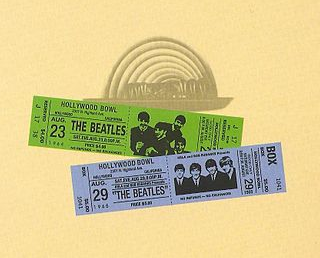
The Beatles at the Hollywood Bowl album cover artRock and Roll has a long history at the Bowl. In fact, The Beatles appeared at the Hollywood Bowl on April 23, 1964, just months after their US debut. Tickets for the show sold out in 3 1/2 hours, with the only sales being through select ticket offices, no online sales. Over 18,000 people packed the Bowl that night. To keep The Beatles safe from the overzealous fans, a smooth getaway scheme was devised. A decoy limo was used to attract the fans, while the band members slipped away in a nondescript Plymouth Valiant. In later appearances at the Bowl, a Brinks armored truck was used to escort The Beatles to and from their hotel to avoid a panic situation.

The screaming crowd at The Beatles first concert was so loud that no one could hear the music. However, it was recorded (as were their two Bowl concerts in August of 1965) and later released as an album under Capitol Records (US) and Parlophone (UK). [image: Wikipedia]

The Beatles 1964 concert became the bench mark for rock and roll concerts at the Bowl, but many famous rockers have played there before and since. To watch The Beatles performing at the Hollywood Bowl on April 23, 1964 go here.

Pre-Concert Picnic Tradition

One of the most engaging customs at the Bowl is the tradition of pre-concert picnicking. Some of the surrounding picnic areas open as early as 4 hours before each concert. Tables are available on a first-come, first-served basis. Those in the private boxes nearest the stage, can choose to enjoy a luxurious dinner served to them by professional wait staff. Whether it’s a casual picnic or box dining, you can’t beat the delightful al fresco dining under the stars. For more information, see the Hollywood Bowl website.

Dining at the Hollywood Bowl


What’s Your favorite outdoor concert venue?


Staging and Props ~ Building Character and Depth Into a Story

07 Monday Jul 2014

Posted by Elizabeth Fais in Film, Story, Writing

≈ 2 Comments

Tags

Elizabeth Fais, Film, Hollywood, Props, Staging, Story, Universal Studios, VIP Tour, Writing

Props for Props

Creating a believable set for film and television is similar to creating believable settings in fiction. It’s all about staging and props. To be honest, I didn’t realize how much time and attention went into building and dressing a set until I took the Universal Studios VIP Tour. Who knew there’s an entire warehouse filled with every type of prop you can imagine? Seriously.

Universal Studios LA props department

The VIP Tour provides an intimate behind-the-scenes view of how they create television and movie magic. An amazing treat, since I love films. But I was surprised that it also gave me insights into how to craft stories with more character and depth. [photos by moi, Universal Studios Hollywood]

Establishing the Setting

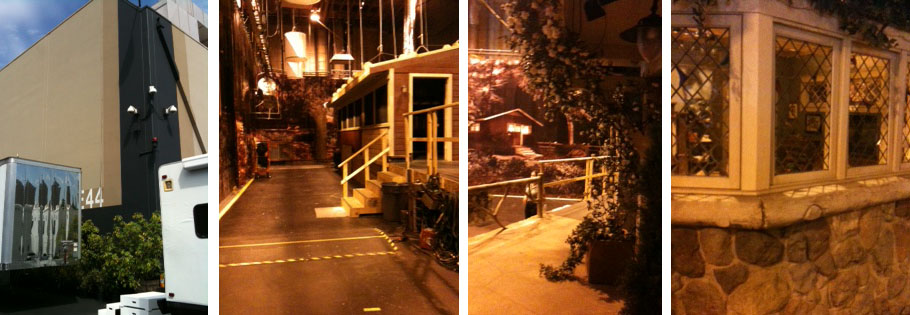
Sound Stage 44 on Universal Studios back lot is where the television show, Parenthood, a NBC family dramedy, is filmed. I learned that it took one day, 12 hours for a team of carpenters to build out the entire set.

Set for Parenthood, Universal Studios, LA

The Craftsman bungalow in Parenthood is set in Berkeley, California. The architecture and location establish the mood and tone of a story, as well as setting expectations for the family that lives there. Their morals, values, even their environmental and political beliefs. If it was a ranch house in Texas, we’d project an entirely different set of expectations on the family. When a setting is fully developed it becomes a character in the story, such as the graveyard in Neil Gaiman’s “The Graveyard Book”.

Dressing the Set

Dressing a set is the process of making it believable, giving it depth that reflects the characters. The Parenthood set took a skilled set designer six weeks to fully dress. The furniture, draperies, books on the bookshelves, pictures on the walls, and the knickknacks were all chosen to reflect the personalities of the people who inhabit the house. Subliminally, those items convey personality and quirks without having to say a word.

Inside the set of Parenthood, Universal Studios, LA

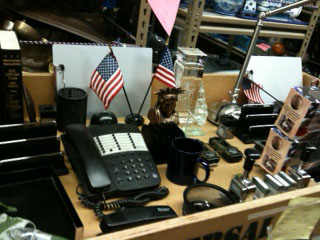
Props are also used to hint at a plot thread or character trait, such as items that are in a bedroom closet, or on display around the room. In an episode of Glee one character was going to enlist in the service, and the set was dressed with patriotic props.

Patriotic props used in an episode of Glee

In fiction, we’re always told “show, don’t tell”. What they fail to say as often is that “what” we show is just important. Too much detail slows a story down. A smattering of well-chosen detail—describing items that convey character and give their personality depth—moves the story forward while keeping the reader engaged.

Staging and props are a craft focus for me in my current project. So, I guess this post is a reminder to myself more than anything.


How do you approach staging and props in your stories?


Calendar

July 2014
M T W T F S S
 123456
78910111213
14151617181920
21222324252627
28293031  
« Jun   Aug »

Enter your email address to have new posts sent directly to your inbox.

Join 236 other subscribers

It's really me!

  • Elizabeth Fais's avatar Elizabeth Fais

Life is Tweet

Follow @elizabethfais

Recent Posts

  • The true POWER of stories
  • Wisdom of Richard Peck ~ Writing for young readers
  • The Writer and Rabbit Who Saved the Countryside
  • 3 TREE-rific Informational Picture Books
  • Musings from the Writing Cave
  • MG Review ~ HOW I BECAME A SPY
  • The “Creative High” is real!

Past Posts

Officially SCBWI

Reading Fun

Advice for Writers

I Write for Apples

Author Photos

Olivia Marshall

Categories

Amazing but true! Animals Animation Blake Snyder Book Reviews Books Cats Character Dancing Disneyland Elizabeth Fais Fiction Fun Facts Funny Videos Giveaway Giving Back Holiday Humor Inspiration Middle Grade Movies Music Mystery Nonfiction Paranormal Reading Romance SCBWI Shakespeare Story Supernatural Thriller Uncategorized Winner! Writing YA YAppiest Young Adult Zombies

Blog at WordPress.com.

  • Subscribe Subscribed
    • Elizabeth Fais
    • Join 236 other subscribers
    • Already have a WordPress.com account? Log in now.
    • Elizabeth Fais
    • Subscribe Subscribed
    • Sign up
    • Log in
    • Report this content
    • View site in Reader
    • Manage subscriptions
    • Collapse this bar
 

Loading Comments...