
• About Me
  • Writer’s Corner

Elizabeth Fais

~ Where awesome begins…

Elizabeth Fais

Tag Archives: Crenshaw

Keeping it real ~ Tackling tough topics for the youngest readers

26 Tuesday Jun 2018

Posted by Elizabeth Fais in Books, Middle Grade, Picture Books, Reading

≈ Leave a comment

Tags

Baseball, Coretta Scott King Honor Award, Crenshaw, discrimination, E.B. Lewis, Elizabeth Fais, Gavin Curtis, homelessness, Horn Book, Horn Book Magazine, imaginary friend, Katherine Applegate, Middle Grade, Music, Negro League, Picture Books, segregation, starred review, The Bat Boy and His Violin, Violin

The sweet innocence of childhood should be cherished and preserved for as long as possible, but shielding children entirely from harsh realities doesn’t do them a service. There are levels of truth. The youngest readers shouldn’t be unnecessarily exposed to gritty topics. However, there are plenty of stories that address tough topics in a way that builds empathy and understanding.

The two books I want to focus on here broach the topics of discrimination and homelessness in a gentle way.

The Bat Boy and His Violin, cover

The Bat Boy and His Violin

By Gavin Curtis, Illustrated by E. B. Lewis

The Bat Boy and His Violin, illustration by E.B. LewisReginald loves to create beautiful music on his violin. But Papa, manager of the Dukes, the worst team in the Negro National League, needs a bat boy, not a “fiddler,” and traveling with the Dukes doesn’t leave Reginald much time for practicing. Soon the Dukes’ dugout is filled with Beethoven, Mozart, and Bach — and the bleachers are filled with the sound of the Dukes’ bats. Has Reginald’s violin changed the Dukes’ luck—and can his music pull off a miracle victory against the powerful Monarchs? 

Gavin Curtis’s beautifully told story of family ties and team spirit and E. B. Lewis’s lush watercolor paintings capture a very special period in history. [Synopsis]

The Negro Leagues were United States professional baseball leagues comprised predominantly of African-Americans, beginning in 1920, with a final season in 1951. On the surface, this story is a view into racial discrimination and segregation in the United States prior to the Civil Rights movement.

On a deeper level, this story addresses the all too frequent discrimination of the arts over sports. Reginald serves as a heroic role model, in that he honors his father’s wishes without giving up his true passion. In the end, father and son strengthen their bond through their acceptance and new-found appreciation of one another.

E. B. Lewis won the Coretta Scott King Honor for Illustrations for his rich and nuanced watercolors that enliven this moving, heartfelt story.

Crenshaw

By Katherine Applegate

Jackson and his family have fallen on hard times. There’s no more money for rent. And Crenshaw, covernot much for food, either. His parents, his little sister, and their dog may have to live in their minivan. Again.
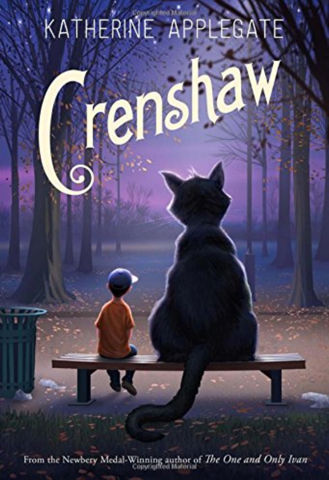
Crenshaw is a cat. He’s large, he’s outspoken, and he’s imaginary. He has come back into Jackson’s life to help him. But is an imaginary friend enough to save this family from losing everything? [Synopsis]

Katherine Applegate tackles a tough topic in Crenshaw, shedding light on the realities of hunger and homelessness. As difficult as this topic is, Applegate artfully infuses the story with empathy and lighthearted humor. I was sold with the opening paragraph:

I noticed several weird things about the surfboarding cat. Thing number one: He as a surfboarding cat. Thing number two: He was wearing a T-shirt. It said CATS RULE, DOGS DROOL. Thing number three: He was holding a closed umbrella, like he was worried about getting wet. Which, when you think about it, is kind of not the point of surfing.

Told from the viewpoint of nine-year-old Jackson, we watch as he shields his younger sister from the terrifying reality of their family’s financial uncertainty, and feel the shame that threatens to cut him off from his best friend. Applegate masterfully shows how the family’s problems play out through Jackson’s eyes, and finally resolve in a safe and satisfying ending that is true to the story’s premise.

The tone is warm and, occasionally, quirkily funny, but it doesn’t sugarcoat the effects of hunger and vulnerability. This novel adds a middle-grade perspective to the literature of imaginary friends and paints a convincing and compassionate portrait of a social class―the working poor―underrepresented in children’s books. ―The Horn Book, starred review


What books that touch on tough topics
would you recommend for young readers?


The Music of Words

19 Thursday Jan 2017

Posted by Elizabeth Fais in Music, Writing

≈ Leave a comment

Tags

Am Writing, Crenshaw, Elizabeth Fais, Katherine Applegate, Maggie Stiefvater, Martha Brockenbrough, Mary E. Pearson, Music, Shiver, Stephen King, Story, The Beauty of Darkness, The Game of Love and Death, Truman Capote, Writing

shutterstock_379805902_flipThere is music in words. Listen to a conversation in a language you don’t understand and focus on the lyrical quality. When you aren’t distracted by what is being said, you hear the rhythm of the words and the melody in the tones.

Written words are musical as well. A story, in essence, is a symphony of syllables. Writers weave words into melodies, sentences that flow into passages, then swell into movements.

Writers hear the words as they are put onto the page, as if they being spoken. Their structural tempo evokes mood and conveys emotion. A character’s purpose and journey is intertwined with the melody. The author’s voice is the harmonic fabric that blends intertwining melodies into a vibrant whole.

Many writers find inspiration, and connect with the inner muse, through music. The proof is in the playlists they post on social media, different music for each story.

Find Your Writing Rythm

A writer’s rhythm is their voice. I already have a blog post on The Illusive “Voice” ~ What Editors Want and Writers Seek, so I won’t go into that again. Instead I’ll cut to the chase, to the three simple steps anyone can use to find their unique voice:

  1. Read. Read. Read.
  2. Write. Write. Write.
  3. Repeat.

Read everything in your genre, then read widely in other genres. When you find an author whose style resonates with you, read everything they’ve written. Then read those books again. In the sheer act of reading and rereading their words, you absorb the rhythm of the prose, which miraculously transforms into your own unique voice.

If you don’t have time to read, you don’t have the time or tools to write. ~Stephen King

A writer’s voice isn’t a static. The quality of voice evolves as a writer hones and polishes their craft. It takes both reading and writing to discover your writing rhythm, your voice.

Making Music with Words

A story is a symphony of syllables, with possibilities as rich and varied as the imagination. The following excerpts are from books by remarkable authors, each with a unique voice.

Shiver
by Maggie Stiefvater
: As the hours crept by, the afternoon sunlight bleached all the books on the shelves to pale, gilded versions of themselves and warmed the paper and ink inside the covers so that the smell of unread words hung in the air. That was what I loved, when I was human.

The Game of Love and Death
by Martha Brockenbrough: 
“If life didn’t end,” he [Love] said, “there would be no need for me. To choose love indreamstime_xs_182186 the face of death is the ultimate act of courage. I am the joy, but you [Death] are the meaning. Together, we make humanity more than it otherwise might have been.”

The Beauty of Darkness
by Mary E. Pearson: 
The world flickered, pulling us into protective darkness, and I was in his arms again, our palms damp, searching, no lies, no kingdoms, nothing between us but our skin, his voice warm, fluid, like a golden sun, unfolding every tight thing within me, I will love you forever, no matter what happens.

Crenshaw
by Katherine Applegate
: I noticed several weird things about the surfboarding cat. Thing number one: He as a surfboarding cat. Thing number two: He was wearing a T-shirt. It said CATS RULE, DOGS DROOL. Thing number three: He was holding a closed umbrella, like he was worried about getting wet. Which, when you think about it, is kind of not the point of surfing.

Truman Capote understood the music of words. For him, it was the joy of writing.

To me, the greatest pleasure of writing is not what it’s about, but the inner music the words make.~Truman Capote

What story do you need to write, what symphony do you have to play?
Music of words


Calendar

December 2025
M T W T F S S
1234567
891011121314
15161718192021
22232425262728
293031  
« Nov    

Enter your email address to have new posts sent directly to your inbox.

Join 236 other subscribers

It's really me!

  • Elizabeth Fais's avatar Elizabeth Fais

Life is Tweet

Follow @elizabethfais

Recent Posts

  • The true POWER of stories
  • Wisdom of Richard Peck ~ Writing for young readers
  • The Writer and Rabbit Who Saved the Countryside
  • 3 TREE-rific Informational Picture Books
  • Musings from the Writing Cave
  • MG Review ~ HOW I BECAME A SPY
  • The “Creative High” is real!

Past Posts

Officially SCBWI

Reading Fun

Advice for Writers

I Write for Apples

Author Photos

Olivia Marshall

Categories

Amazing but true! Animals Animation Blake Snyder Book Reviews Books Cats Character Dancing Disneyland Elizabeth Fais Fiction Fun Facts Funny Videos Giveaway Giving Back Holiday Humor Inspiration Middle Grade Movies Music Mystery Nonfiction Paranormal Reading Romance SCBWI Shakespeare Story Supernatural Thriller Uncategorized Winner! Writing YA YAppiest Young Adult Zombies

Blog at WordPress.com.

  • Subscribe Subscribed
    • Elizabeth Fais
    • Join 236 other subscribers
    • Already have a WordPress.com account? Log in now.
    • Elizabeth Fais
    • Subscribe Subscribed
    • Sign up
    • Log in
    • Report this content
    • View site in Reader
    • Manage subscriptions
    • Collapse this bar
 

Loading Comments...